Pride at MoonStone MPLS: Events, Workshops, and Community All June Long
MoonStone MPLS celebrates Pride Month with workshops, fundraisers, art installations, and community events at 3304 East Lake Street in Longfellow, Minneapolis.
On September 17, 2026, I joined Dixie Treichel on Fresh Fruit, KFAI's queer radio show, alongside David Wenzel and Joshua Larson of Wild Things Collective. We talked about how MoonStone started, why we moved to Longfellow, and what this year has taught me about generosity. Here's my part of the conversation.
You've had the opportunity to work for a lot of other small businesses. Tell us a little about yourself.
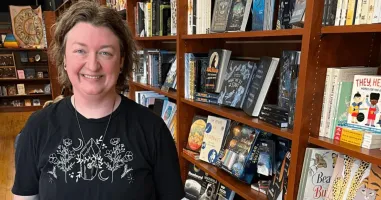
My name is Brenna Wernersbach. I use they/them pronouns. I had the opportunity to work for a bunch of other little small businesses across the past decade. I think I was kind of a pain in the butt employee. I was a really good employee for the first six to nine months, and then I was the employee with maybe too many ideas. So shifting into the driver's seat of running my own business has really helped me to create the space that I wanted to be in, and then share that space with others.
In addition to metaphysical resources, we have a lot of natural history and natural science resources. I describe us as where the metaphysical shop meets the natural history museum gift shop, with the idea that we get to know ourselves and connect with something greater, ground ourselves, connect with each other.
Sharing our store as a community space has become a central part of our mission. We have classes almost every week night. We have service providers like astrology and tarot readers who come in on Fridays. And then we have small businesses and other artists pop up on Saturdays and Sundays and sell their work directly. A lot of those artists go on to be consignment vendors within our shop. It's just been such a cool experience seeing people at all different levels of development of their small business and giving them an opportunity to connect.
And then also creating a space that I call queer normative, that you don't need to come out there. You can look around and see ways that all different identities are represented and welcomed and supported in our space. We get a lot of people who are visiting from out of state or thinking about moving to Minnesota, and they get referred to us, and they come in and they get the sense of, this is a community where I could connect. Not just MoonStone, but the Twin Cities in general. So it's been really incredible to become an ambassador in that way in welcoming folks.
I'm just so grateful to be part of a community and be able to be myself every day at work, and create a space for other people to feel like they can do that too.
How did you become interested in stones and gems?
I was always kind of a curious kid. I was into science. We were just talking about the X-Files. I was into cryptozoology and weird spooky stuff. I was a Buffy kid.
But my real love of rocks developed in my current partnership. My girlfriend taught me how to pick agates. And so everywhere I went, every parking lot, every gravel road, we're picking agates and filling our pockets, which then led to we'll stop in every rock shop that we come by, and I needed one of everything and then a bigger one of everything. And then I ended up working at a metaphysical shop. So my collection and my knowledge kind of grew organically just by my interest and being around them.
I worked for an uptown metaphysical shop called the Eye of Horus. I started working with them in 2019. They were a really cool business that was lesbian owned and a real community center for the Pagan community. After 20 years, the owner retired from retail, and that left that physical space available.
So my story is kind of similar [to Wild Things Collective]. I had these ideas. I was a consignment artist at that shop and some other shops. I did pop-up markets. I really experimented with being a little guy and starting your own business. And then when the opportunity to move into a storefront presented itself, I couldn't pass it up.
We spent one year operating in Uptown. And there were just so many barriers to accessibility there. There's always construction. It's always an uphill battle to find parking. Other businesses are struggling. So it's not like you go there and have a whole day of shopping. And we're really wellness oriented and about slowing down and touching grass. And there's not grass in Uptown. You don't feel like you're slowing down when you've had to go through that kind of gridlock to make it through the neighborhood.
So after about six to nine months in the Uptown location, I started looking for something else, and I found this place in Longfellow. It's right next to the Sonora Grill. So I moved from West Lake Street to East Lake Street. But I felt very connected to the Longfellow neighborhood. I'd lived there for about a decade. I had worked for Blue Moon Coffee Shop for a while. I worked for Geek Love Cafe within Moon Palace Books. So bringing my own moon over to East Lake Street felt like really coming full circle.
It's been really valuable to sprout where I had the opportunity, but then transplant our community to a place where it felt like we could really spread our roots and plan to be there for a long time.
Now we're in our second year in the Longfellow location. We've got a parking lot. We've got an accessibility ramp. We've got two single stall restrooms. We've got air conditioning. It's much more comfortable for me and my employees and for our guests. When they want to come, they can come, and they don't face as many barriers. And we've just seen so much growth, especially now being in our second year in the same address, which makes me so excited about our future in Longfellow.
We're talking about community, and how small businesses connect with the community around them. Do you want to talk about that?
What I have learned this year in particular is that abundance gets more abundance, and generosity breeds more generosity.
Our business is on Lake Street, which means we were impacted in January. There was a lot of fear among small businesses, and there were so many challenges to our whole community. I didn't know what that was going to look like. Our small businesses didn't know how we would do. And what I found was that our community members, our shoppers and our neighbors, came to the store pretty frequently, even to ask how we were doing. We became a resource share where people would drop off whistles and folks could just come in and get them. We had red cards with people's rights on them. We collected food donations, which we're still doing for Soup for You Café, also in the Longfellow neighborhood.
We actually experienced growth during a period that other businesses were shut down out of fear. We were incredibly privileged to be successful through that period. But I think what contributed to that success was the helping hands that were connecting with each other in the space that we made available.
So starting in January and then almost monthly throughout this year, we've offered shopping weekends where we advertise that we'll be donating 20% of our sales revenue from that weekend to different identified community resources, whether that was rent relief, mutual aid... In Pride season, we did that for RECLAIM and for Queer Space Collective.
Business advice is like, “always be careful when you do a sale, you can't donate too much, or how will you meet your bottom line.” And what we experienced was we had so much more foot traffic on donation weekends than we ever had on sales event weekends, that we've scrapped the idea of sales. What we do is we contribute to the community, and our customers see that, and they'll say, “okay, well today I'm going to buy that bigger piece that I've had my eye on. And I'm actually going to buy two of these this time, because I support what you're donating to.”
And so everybody does better. Our customers treat themselves or buy extra gifts for their friends. We experienced increased revenue, and then we're able to contribute that. So that scarcity driven mindset of “you've got to cover your own bases and you can't be giving things away” is just totally not true. It's propaganda. It's false competition that keeps people afraid.
As we have leaned into being generous with donations, our community has been generous with their support. It's just this upward spiral that I'm so proud to be in the midst of. I'm proud that that's the type of customers that come to us. I'm proud of the impact that we've been able to have on other community organizations. It's just so incredible to see generosity contributing to growth, and that cycle repeating.
What's it like to have a queer-owned business, and to be a queer business owner?
I didn't set out to run a queer-owned business. I just happened to be a queer-identified person who owns a business. And that means it's reflected around me. That means that if I'm being visible, people can see that.
At first, I was a little bit scared of that. If I add “queer-owned” to my business tagline, how many people does that alienate? And I don't know, do I even care about that? Do I want those people there? But more than that, does that make my business vulnerable? Does that make the community I'm trying to create a safe space for a vulnerable target, by the nature of being visible?
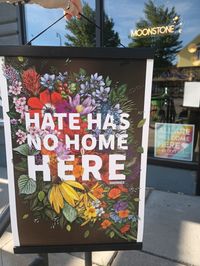
So it's important to me that our safe space stays protected. You'll see rainbows throughout the store, but not on our front window. And you'll find queer artists and authors integrated throughout the shop. So it's sort of like, if you know, you know. You'll see it and you'll recognize the representation. And if you're just looking for rocks and a metaphysical shop, you might wander in and start having some experiences that you didn't predict, like feeling comfortable with a queer person, having a positive experience, and starting to think about things in new ways.
That sort of allyship was really important to me, that we can invite in people who are not just questioning their own identity, but maybe questioning their status as an ally, and having positive experiences.
And then I also started to realize, as a visibly queer person, a person who uses they/them pronouns in my bios, I am creating a model not just for younger people. In the Longfellow neighborhood, we get so many more families with young kids that come in. Not only am I a model to those children, I'm a model to their parents, that a queer and non-binary person can grow up and have a normal and successful life.
I think if my parents had been able to see healthy, successful queer people in non-stereotyped ways, it would have supported them in supporting me. When I came out, my parents didn't reject my queerness. They grieved the idea that I was going to have a harder lived experience.
So I feel like that's my biggest honor as a visibly queer person, to create this representation for parents, to give them hope and optimism in supporting their kids in being who they are.
It's so fun to see gender creative kids coming through and watch their parents support them, or, like Joshua said, have parents come out to me and tell me about their experience in supporting their children. A lot of times these aren't people that you would stereotypically clock as members of the queer community. They seem like very mainstream parents, and to know that they have the backs of their kids is so healing to me. Not because of my personal experience, but because of the generational experiences of queer people who didn't get that support, whether it was because of their family's beliefs or because of their family's fears for what they would face.
Thanks to Dixie Treichel and Fresh Fruit on KFAI. Listen to the full episode here, and see what's coming up at the shop on our events calendar.